January 26, 2026

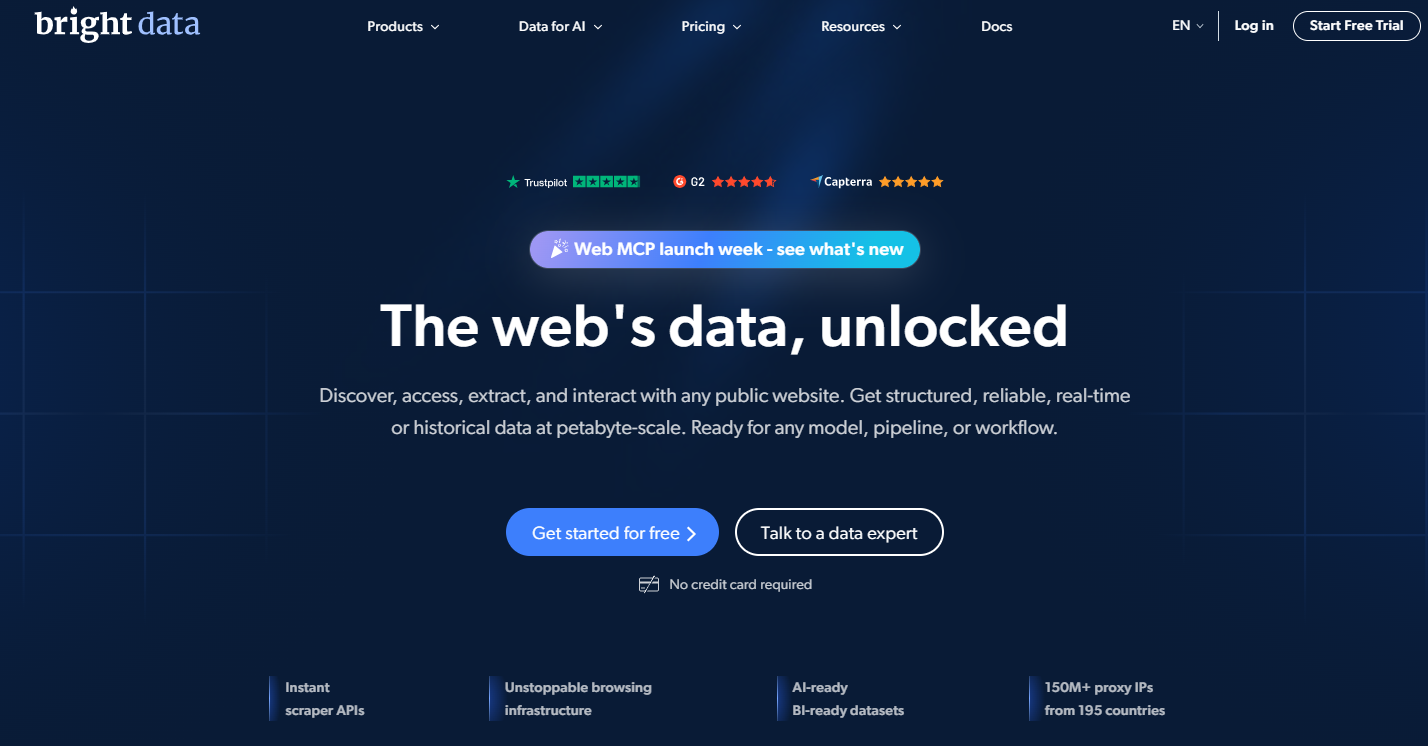

Are you looking for a reliable way to gather public information from the internet? Bright Data is a premier web data platform designed for large-scale data collection and extraction. Formerly known as Luminati Networks, it provides the tools you need for effective market research and market intelligence. Using a sophisticated system of AI agents and proxies, Bright Data allows you to access and structure web data, turning the vastness of the internet into a valuable resource for your business.
Bright Data's web indexing service acts like a powerful backend system that helps you perform data scraping on a massive scale. This feature is designed for enterprises needing to index and extract information from millions of web pages, much like a search engine.
This web data platform combines its proxy network with advanced unblocking technology to ensure your data collection is successful. Whether you need pre-made datasets or custom data for specific use cases, Bright Data’s AI agents make the process efficient and resilient. Let's look closer at how it works and what data you can access.
So, how does Bright Data manage such effective web data collection? The process begins with its powerful Web Unlocker. This tool is specifically designed to bypass common obstacles like captchas and bot detection systems that often stop web scraping attempts in their tracks. It automates the process of getting past these barriers, ensuring you can access the data you need.
Next, the system utilizes a massive proxy network. By routing your requests through millions of different proxy IPs, Bright Data masks your digital footprint. This IP rotation is key to avoiding blocks and accessing geo-restricted content, making your data collection efforts appear like traffic from genuine users around the world.
For an even more integrated experience, the Scraping Browser provides a no-code interface for data extraction. This tool combines the power of the proxy network and the Web Unlocker, allowing you to perform complex web scraping tasks without writing code. It’s an all-in-one solution for turning websites into structured data with the help of AI agents.
One of the greatest strengths of Bright Data is the sheer variety of public web data you can access. The platform is capable of performing data extraction from a wide range of sources, turning unstructured online information into organized datasets. This is especially useful for businesses that rely on comprehensive market intelligence.
You can gather information from major social media platforms, popular e-commerce sites, and search engines. This allows you to monitor trends, track competitor pricing, and analyze public sentiment. The platform provides access to pre-collected datasets from over 100 domains, simplifying your research process significantly.
Here are some examples of the types of public information you can index:
At the heart of Bright Data's web indexing capabilities lies its extensive proxy network. This network is a global collection of proxy IPs that make your data collection tasks possible. When you are scraping data from the web, using a proxy is essential for avoiding detection and blocks. Bright Data’s proxy services are built to handle high-bandwidth tasks with ease.
This infrastructure is crucial for accessing geo-restricted content and ensuring your scraping activities remain anonymous and uninterrupted. By leveraging a pool of residential IPs and other proxy types, you can make your requests look like they are coming from real users anywhere in the world. Now, let’s explore the role of these proxies in more detail and the different types available.
Using a proxy is fundamental for secure web scraping. When you access a website, your IP address is visible. For large-scale scraping, repeated requests from the same IP can trigger anti-bot measures, leading to blocks. A proxy acts as an intermediary, masking your real IP with one from its network. This is where IP rotation becomes crucial, as it automatically switches between different proxy IPs for each request.
This process not only prevents you from being blocked but also enhances data protection. Bright Data is committed to ethical privacy practices and operates within legal frameworks like GDPR and the EU data protection regulatory framework. The company ensures that it only scrapes public web data and follows strict compliance standards, making it a safer choice than many free proxy providers.
Whether you use datacenter, ISP, or residential proxies, you are adding a layer of security and efficiency to your scraping operations. By managing your digital identity responsibly, you can gather the data you need without compromising your privacy or violating website terms of service.
Bright Data offers one of the most diverse proxy networks on the market, ensuring you have the right tool for any scraping job. Each of the proxy types serves a different purpose, from high-speed bulk scraping to tasks that require the highest level of anonymity. Understanding these options helps you optimize your data collection strategy.
Residential proxies use real user IPs from actual devices, making them extremely difficult to detect. For tasks that are less sensitive to detection, datacenter proxies offer a faster, more cost-effective solution. Mobile proxies provide IPs from 3G/4G networks, which are ideal for accessing mobile-specific content or testing app performance.
This variety allows you to tailor your approach based on the website you are targeting and your specific goals. Here is a breakdown of the main proxy types and their common uses:
Proxy Type
Description
Best Use Cases
Residential Proxies
Real user IPs from devices, offering high anonymity.
Scraping, ad verification, social media, search engine crawling.
Datacenter Proxies
Fast IPs from data centers, more easily detected.
Bulk scraping and price monitoring.
ISP Proxies
Real IPs hosted in data centers with great uptime.
Market research, SEO, and tasks requiring reliable uptime.
Mobile Proxies
3G/4G IPs from mobile carriers for ultimate anonymity.
Social media tasks, app testing, and geo-sensitive scraping.
While people often use the terms web crawling and web scraping interchangeably, they describe two different parts of the data collection process. Web crawling is the act of systematically browsing the internet to discover and index URLs, similar to what a search engine does. Web scraping, on the other hand, is the process of extracting specific data from the HTML of those pages.
Bright Data provides tools for both. You can use its infrastructure for large-scale web crawling to find relevant pages for market research. Then, you can use tools like the scraper APIs or the Scraping Browser to perform targeted web scraping and pull structured public web data. Let's explore the key differences and use cases for each.
The main difference between web crawling and web scraping lies in the objective. Crawling is about discovery—finding out what pages exist. Scraping is about extraction—pulling specific pieces of information from those pages. Think of a crawler as a librarian mapping out all the books in a library and a scraper as someone who opens a specific book to copy a paragraph.
Bright Data's tools cater to both needs. Its robust infrastructure can be used to crawl vast sections of the web to identify pages relevant to your market research. Once you have a list of target URLs, you can deploy AI agents or use the Scraping Browser to perform precise web scraping and collect the public web data you need.
Here are some distinct use cases:
For developers who want to integrate web data extraction directly into their applications, Bright Data’s Scraper APIs provide a powerful solution for automation. These APIs allow you to launch and manage scraping jobs programmatically, making your data collection workflows highly efficient. You can get structured data delivered in formats like JSON, ready for analysis.
The API handles many of the complexities of Bright Data scraping, such as rotating proxies, managing request headers, and solving captchas automatically. This allows you to focus on the logic of your data extraction rather than the challenges of accessing the web. It's a scalable way to power applications or machine learning models with fresh data.
You can integrate these APIs with popular programming languages and tools like Selenium to build custom scrapers. Whether you are building a price comparison engine or training AI agents, the API provides the flexibility and power needed for sophisticated scraping and web data extraction tasks.
KeywordSearch has an AI Audience builder that helps you create the best ad audiences for YouTube & Google ads in seconds. In a just a few clicks, our AI algorithm analyzes your business, audience data, uncovers hidden patterns, and identifies the most relevant and high-performing audiences for your Google & YouTube Ad campaigns.
You can also use KeywordSearch to Discover the Best Keywords to rank your YouTube Videos, Websites with SEO & Even Discover Keywords for Google & YouTube Ads.
If you’re looking to SuperCharge Your Ad Audiences with AI - Sign up for KeywordSearch.com for a 5 Day Free Trial Today!
In conclusion, understanding Bright Data Web Indexing is essential for anyone looking to leverage public web data effectively. This comprehensive guide has highlighted how Bright Data’s innovative technology streamlines the process of web scraping and data collection, ensuring that users can access accurate and reliable information with ease. By utilizing their proxy networks and API, you can automate your data strategies while maintaining security and efficiency. As the digital landscape continues to evolve, staying informed about tools like Bright Data will empower you to make data-driven decisions confidently. If you're ready to explore how Bright Data can enhance your web indexing efforts, don’t hesitate to reach out for more information!
Yes, using Bright Data for web indexing is considered safe and legal when done responsibly. The platform is designed to access only public web data and adheres to major data protection laws like GDPR. Bright Data follows ethical privacy practices, ensuring its services are compliant and used for legitimate purposes.
Bright Data offers flexible pricing options, including pay-as-you-go and monthly subscription plans. The cost varies based on the service, bandwidth, and proxy type used. While a free trial is available for certain products like the Web Unlocker, most services require an initial payment. You can also purchase pre-made datasets.
If a Bright Data application appears in your taskbar, you can typically uninstall it like any other software through your computer's control panel or settings. If it's a browser extension, you can remove it directly from your browser's extension management page to protect your privacy and stop its proxy services.